When Trust Fails: How to Give Children a Safe Path to Help
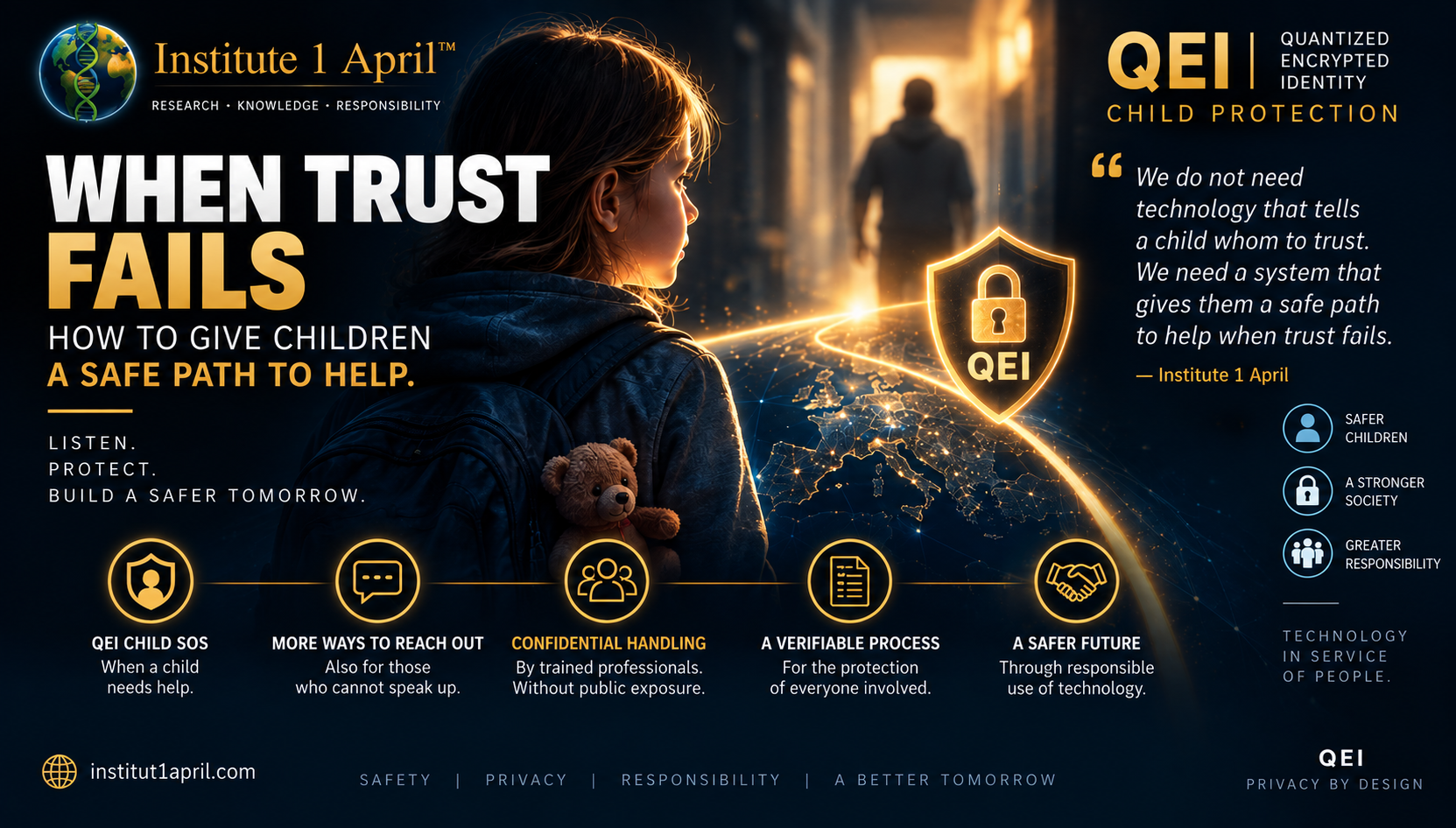
A coach, teacher, mentor, educator or another adult can play an important role in a child’s life and may hold a significant position of trust. But what happens when that very relationship of trust and authority becomes a space for pressure, fear or potential abuse? Digital identity alone cannot prevent this. But it raises an important question: can we provide children with a safe, independent and verifiable path to help that protects their rights and privacy while also protecting the rights of the person who is the subject of a report?
When the danger is not a stranger on the internet
When discussing child protection in the digital environment, we often talk about fake profiles, age verification, online grooming, inappropriate content and contact with strangers.
But the risk is not always an anonymous person on the other side of a screen.
Sometimes it is an adult the child knows and who, because of their position, holds a certain degree of authority or influence.
This may be a coach, teacher, mentor, educator or another person entrusted with the care or supervision of a child.
Such circumstances raise a much more difficult question:
How can a child seek help if the person representing authority or a trusted environment is also the person because of whom the child needs help?
A recent case raises a broader question
In September 2026, Slovenian media reported testimonies from former female riders in Velenje who alleged sexually inappropriate conduct and abuse of position by a riding coach. According to reporting by Siol, some described alleged offers of benefits, pressure and fear of consequences.
It is important to emphasize that these are allegations and testimonies and should be treated as such, not as a predetermined finding of an individual’s guilt.
For the development of child protection systems, however, such cases raise a broader systemic question:
Does a child or minor have a safe way to raise a concern outside the immediate environment in which the problem arose?
QEI cannot prevent such abuse
Here, the limits of technology must be clearly defined.
QEI cannot know what is happening between a coach and an athlete, a teacher and a student, a mentor and a young person, or between other individuals.
It cannot know what someone said behind closed doors.
It cannot independently assess psychological pressure, relationships, consent or potential abuse of authority.
And most importantly:
no digital identity system can replace the people and institutions that are professionally and legally responsible for protecting children.
Technology could, however, help with something else:
the child’s path to help.
What if a child cannot report the problem within the same environment?
Imagine a young athlete experiencing a problem with a coach.
If she must first report the problem to that same coach, one of the coach’s immediate colleagues or an organization on which her sporting future depends, a conflict of interest may arise.
A child or young person may fear losing training opportunities, competitions, their position within a group, friendships or their future in sport.
Similar power relationships can also occur in schools, cultural institutions, clubs, camps and other environments.
There should therefore be a channel that is independent of the immediate relationship of power.
A verified adult is not necessarily a “safe person”
Within QEI Child Protection, it could be possible to explore a model in which certain professional roles of adults working with children are digitally verifiable.
For example, the system could confirm:
IDENTITY VERIFIED
the person’s identity has been verified
ORGANIZATION VERIFIED
their connection to an organization has been verified
ROLE VERIFIED
their current professional role has been verified
AUTHORIZATION VERIFIED
the appropriate authorization for a specific function has been verified
But there must be a very clear boundary.
A label such as VERIFIED COACH or VERIFIED ADULT – AUTHORIZED ROLE would not mean:
SAFE PERSON.
A digital system can verify identity, role and a specific authorization.
It cannot cryptographically verify a person’s character or guarantee their future behavior.
“A digital system cannot confirm that an adult is trustworthy. But it can verify who they are, what role they hold, and where a child can turn if that very person becomes part of the problem.”
— Institute 1. april
QEI Child SOS – an independent path to help
This is where the potential role of QEI CHILD SOS™ emerges.
A child could use a protected system to request help without first having to report the problem to the person or organizational level to which the concern relates.
But the first step should not require a lengthy report.
The child would not necessarily have to write:
“This person is abusing me.”
It might be enough to say:
“I don’t feel safe.”
or:
“I want to talk to someone privately.”
or:
“Please check whether I am safe.”
This would initiate a protected safeguarding process, not an automatic accusation.
What if the child does not have the courage to press SOS?
This may be one of the most important questions in the entire concept.
A child experiencing pressure or potential abuse will not necessarily press a help button.
They may feel ashamed.
They may feel embarrassed.
They may fear that no one will believe them.
They may fear the adult’s reaction.
They may fear consequences for their family, sporting future, school or friendships.
They may be emotionally attached to the person causing them distress.
And in some cases, a child may not yet even understand that certain behavior is inappropriate.
A child protection system must therefore not be based on the simple assumption:
“If something is wrong, the child will press SOS.”
One button is therefore not enough
QEI Child Protection should explore several different paths to help.
One option could be the direct QEI Child SOS™.
Another could be a much less explicit request:
“I want to talk to someone.”
A third option could be QEI Silent Alert™ – a discreet way of triggering a safety signal.
A fourth option could be connected to the QEI Safe Check™ concept, where a simple confirmation is expected in predefined safety circumstances:
“I’M SAFE.”
If the expected confirmation does not arrive, this alone would not mean that abuse or danger has occurred.
But it could provide a reason for a proportionate safety check.
A fifth path should allow another trusted person to raise a concern through an appropriate procedure.
“The most vulnerable child may never press the SOS button. A good protection system therefore cannot have only a help button – it must provide several safe paths through which help can reach the child.”
— Institute 1. april
But there is another danger
If we want to make it as easy as possible for a child to report distress, we must also prevent the signal itself from automatically becoming a public accusation against another person.
Every signal from a child must be taken seriously.
But:
a signal is not evidence.
a report is not a finding of guilt.
And:
suspicion is not a conviction.
This distinction matters for everyone involved.
A report may be well-founded. It may result from a misunderstanding. It may be incorrect. In individual cases, it may also be deliberately false.
Technology must not speculate about the reasons behind a report.
Nor should the system itself decide who is telling the truth.
Protecting the child also means protecting the process
QEI Child Protection should therefore not operate according to the model:
SOS → ACCUSATION → PUBLIC DISCLOSURE
but rather:
SIGNAL
↓
CONFIDENTIAL RECEIPT
↓
IMMEDIATE SAFETY ASSESSMENT
↓
PROFESSIONAL HANDLING
↓
ASSESSMENT OF FACTS AND CIRCUMSTANCES
↓
COMPETENT PROCEDURE IF REQUIRED
The child’s safety must be the first priority.
But the identity of the person who is the subject of the allegations should not automatically become public simply because a signal has been submitted.
Nor should the system automatically send allegations to the media, social networks or the wider public.
QEI would not decide who is telling the truth
That must remain the responsibility of trained professionals and competent institutions through appropriate legal and professional procedures.
QEI could have a much more limited technical role.
For example, it could create cryptographically protected and time-verifiable records such as:
SIGNAL RECEIVED
AUTHORIZED SAFEGUARDING OFFICER ASSIGNED
SAFETY ASSESSMENT INITIATED
RESPONSE RECORDED
REFERRED TO COMPETENT AUTHORITY – IF REQUIRED
The system could therefore help demonstrate that a signal was received and that the responsible institution did not simply ignore it.
But it would not determine:
GUILTY / NOT GUILTY.
Confidentiality must protect both sides
Such a system should follow the need-to-know principle.
Case information should be accessible only to appropriately authorized persons who genuinely need it for the safeguarding or legal process.
This would protect the child.
At the same time, it would also protect the person who is the subject of the allegations from unnecessary public exposure before the facts have been established.
If allegations are not substantiated, the system should not create a permanent public label, digital blacklist or automatic stain on an individual’s digital identity.
If professional assessment identifies grounds for further action, the case could be referred to the competent authorities through the prescribed procedure.
“Protecting a child does not mean judging an adult guilty in advance. A good system must allow a child to speak safely while ensuring a fair, confidential and verifiable process for everyone involved.”
— Institute 1. april
What about the child’s anonymity?
This also raises an important research question.
A child may fear reporting precisely because they do not want their identity to immediately become known to a wider group of people.
It could therefore be possible to explore different levels of identity disclosure.
At the initial stage, the system might prove to the appropriate safeguarding mechanism only something such as:
VERIFIED MINOR
and:
VALID SAFEGUARDING REQUEST
without automatically revealing the child’s complete profile to everyone involved in the process.
If identification became necessary because of immediate danger or a subsequent lawful procedure, the required information could be disclosed only according to predefined rules and only to appropriately authorized persons.
This is connected to one of the fundamental principles behind QEI:
prove what is necessary with the minimum possible disclosure of personal data.
QEI Child Safeguard – verifying the system’s response as well
In child protection, it is not enough to ask whether the child spoke up.
It is also important to ask:
Did anyone listen?
Did someone take responsibility for the signal?
Was the child’s immediate safety checked?
Was the case referred onward when necessary?
This is where QEI CHILD SAFEGUARD™ could play a role.
Its purpose would not be to monitor the child’s life.
It would enable the accountability process to be verifiable:
SIGNAL RECEIVED
↓
RESPONSIBILITY ASSIGNED
↓
SAFETY CHECK REQUIRED
↓
ACTION RECORDED
↓
ESCALATION IF REQUIRED
“Do not track the child. Track whether the system is fulfilling its duty to the child.”
— Institute 1. april
The system must also be protected against its own misuse
Such infrastructure would also introduce serious risks.
It must not become a centralized repository of children’s sensitive stories.
It must not create lists of “suspicious adults” without appropriate procedures.
It must not automatically label people as offenders.
It must not allow institutions to unnecessarily monitor children.
It must not allow legitimate signals to be deleted or concealed.
And it must not allow an unverified report to become a tool for revenge, financial interest, personal disputes or public discrediting.
For this reason, protection of both sides and the integrity of the process would need to be built into the architecture from the beginning.
From Trusted Adult to Trusted Safeguarding Path
This leads to an important change in perspective.
It may not even be appropriate to build the concept around the label:
QEI TRUSTED ADULT.
No technology can guarantee that a particular person will always be trustworthy.
A much more important concept could therefore be:
QEI TRUSTED SAFEGUARDING PATH™
a verifiable, confidential and independent path for a child to reach help.
Such a path should be designed to allow the child to send a safe initial signal without immediately having to prove what happened, provide several ways to ask for help, protect the child’s privacy, prevent the automatic public accusation of another person, ensure professional assessment, record the institutional response and involve competent authorities when necessary.
Technology as a path to people
In child protection, technology must not replace people.
Its role should be exactly the opposite:
to connect the child as safely as possible with the right person when help is needed.
QEI Child Protection should therefore not become a system that attempts to technologically monitor every relationship between a child and an adult.
Nor should it become a system for automatically accusing adults.
The research question is much more balanced:
Can we create infrastructure in which a child has several safe paths to help, an institution cannot simply ignore the child’s signal, and at the same time no one is automatically judged guilty merely because a report has been made?
This is a much more difficult problem than creating an SOS button.
But that is precisely why it is worth researching.
“We do not need technology that tells a child whom they must trust unconditionally. We need a system that gives them a safe path to help when trust fails – and a fair process once verification begins.”
— Institute 1. april
Note: QEI – Quantized Encrypted Identity, QEI Child Protection, QEI Child SOS, QEI Silent Alert, QEI Safe Check, QEI Child Safeguard and QEI Trusted Safeguarding Path are currently development and research concepts of Institute 1. april. This article does not claim that QEI could prevent specific cases of abuse or determine whether a report is true or whether an individual is guilty. Before any potential pilot or practical implementation, technical and security validation, threat analysis, legal assessment, privacy and data protection impact assessments, and the involvement of experts in child protection, psychology, law, criminal procedures, education, sport, cryptography and cybersecurity would be required.