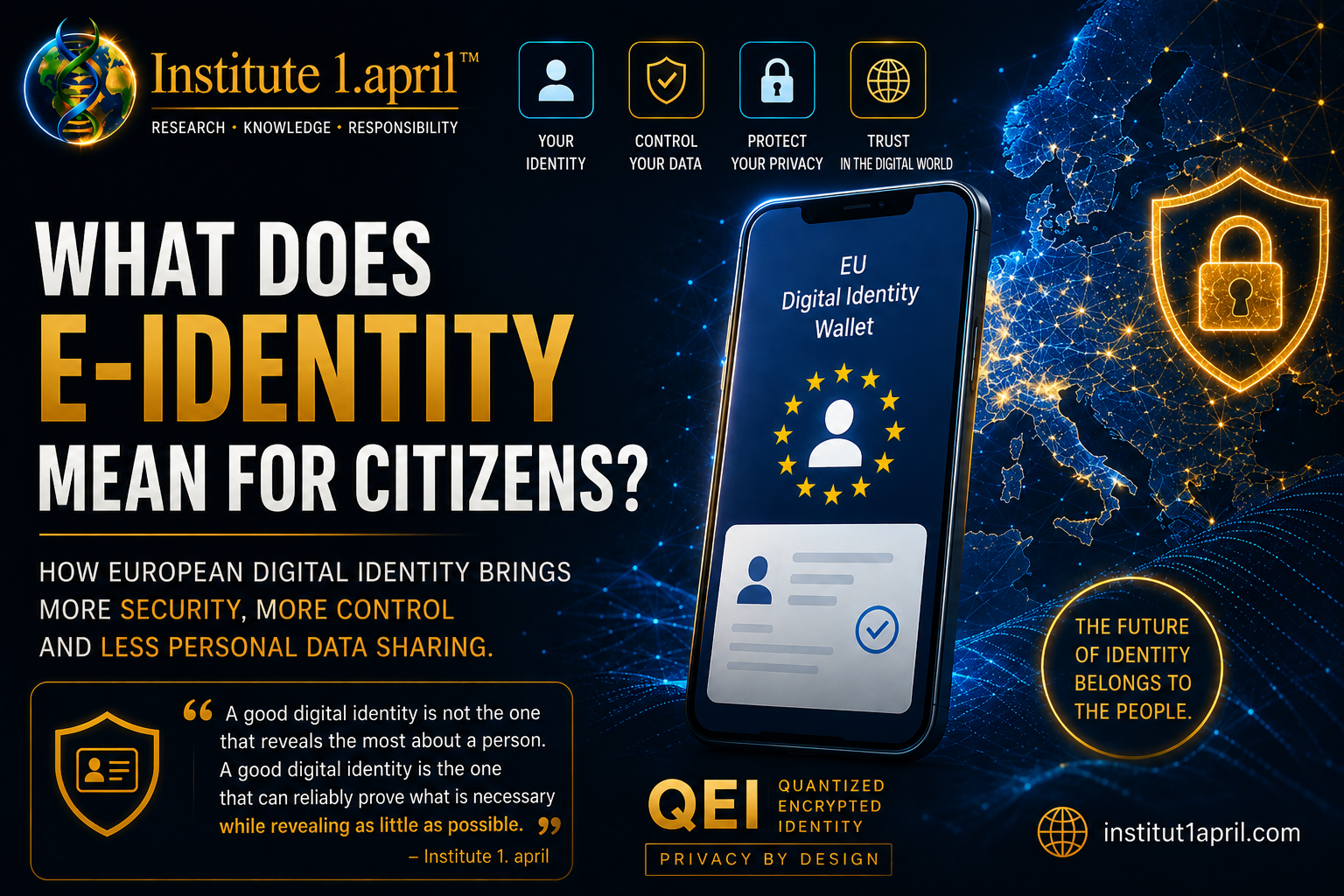
What does e-identity mean for citizens?
Digital identity is becoming one of the key building blocks of the digital society. In the coming years, we will use it not only to access government portals, but increasingly also when interacting with banks, healthcare services, educational institutions, businesses and other digital services.
With the development of the European Digital Identity Wallet (EUDI Wallet), the European Union is establishing a framework in which citizens and residents will be able to use their identity and certain digital credentials through the European Digital Identity Wallet.
But what does this actually mean for the individual?
Digital identity is more than a username and password
For many years, we associated digital identity primarily with a username, a password and perhaps an additional verification code.
But a password is not our identity. It is merely one of the ways we try to prove that we have the right to access a particular account or service.
Modern digital identity goes significantly further.
It can enable electronic proof of identity and the use of verifiable digital credentials in a wide range of situations – from public services and education to banking, travel, document signing and other services.
For citizens, this could mean less repetitive submission of the same information and simpler digital procedures.
Do we always need to reveal our entire identity?
This is one of the most important questions concerning the future of digital identity.
Imagine that an online service only needs to verify whether a user is over 18 years old.
Does it therefore need to know the person’s first name, surname, address and exact date of birth?
Not necessarily.
Modern approaches to digital identity make it possible to develop models in which users can prove a specific attribute without having to disclose more information than the other party actually needs.
Instead of:
“Show me who you are.”
digital identity can gradually move towards the principle:
“Prove only what I need to know.”
This is an important shift.
Greater control over personal data
Digital identity is not only about convenience.
It also raises the question of control.
When we prove our identity digitally, we should understand:
- which data we are disclosing,
- to whom we are disclosing it,
- why the other party needs it,
- how long it will be used or stored,
- who can access it,
- and how we can determine whether access has actually occurred.
This is why principles such as data minimisation, selective disclosure and Privacy by Design are becoming increasingly important in the development of digital identity systems.
What will this mean in everyday life?
For most people, digital identity will become particularly important when it becomes an almost invisible part of everyday activities.
In the future, we could use it to prove our identity when accessing public services, use digital credentials, sign documents electronically, demonstrate certain entitlements or attributes, and complete other procedures for which we currently often use physical documents or multiple separate user accounts.
The key question is therefore not only how many services we will be able to access digitally.
It is also important how the system will protect the individual in the process.
What happens if a digital identity is compromised?
The more important digital identity becomes, the greater the responsibility to protect it.
If someone obtains the password to a single website, an individual user account may be compromised.
But if an attacker were able to misuse a person’s broader digital identity, the consequences could potentially be far more serious.
Future systems therefore cannot rely on a single security element.
Cryptographic protection, multi-factor authentication, secure management of digital credentials, access traceability and architectures that reduce the amount of personal data exposed in each transaction are becoming increasingly important.
“A good digital identity is not one that reveals the most about a person. A good digital identity is one that can reliably prove what is necessary while revealing as little as possible.”
— Institute 1. april
Where do we see QEI in this future?
These are precisely the questions being explored by the QEI – Quantized Encrypted Identity research initiative.
QEI is not a replacement for the European Digital Identity Wallet and is not currently an implemented system. It is a research concept intended to explore whether individual elements of digital identity can be designed in ways that further reduce the exposure of original personal and sensitive data.
Areas of research include data minimisation, cryptographic protection, local processing of sensitive information, multi-factor authentication, access traceability and the principle of Privacy by Design.
The central question is simple:
Can future systems reliably confirm what an individual needs to prove without revealing more of their identity than is necessary?
This question becomes even more important as digital identity moves from individual online services towards becoming part of the broader infrastructure of society.
Digital identity must remain at the service of people
Technological development alone does not guarantee trust.
Citizens must know that the system does not use their identity more broadly than necessary, that sensitive data is adequately protected and that they have genuine control over how it is used.
The future of digital identity will therefore not be determined solely by what technology is capable of doing.
It will also be determined by how much privacy we are able to preserve while using it.
Digital identity can provide citizens with simpler services, greater security and fewer administrative barriers.
But its most important measure should remain the individual:
greater security, greater control and less unnecessary disclosure of personal data.