Crime in the age of artificial intelligence
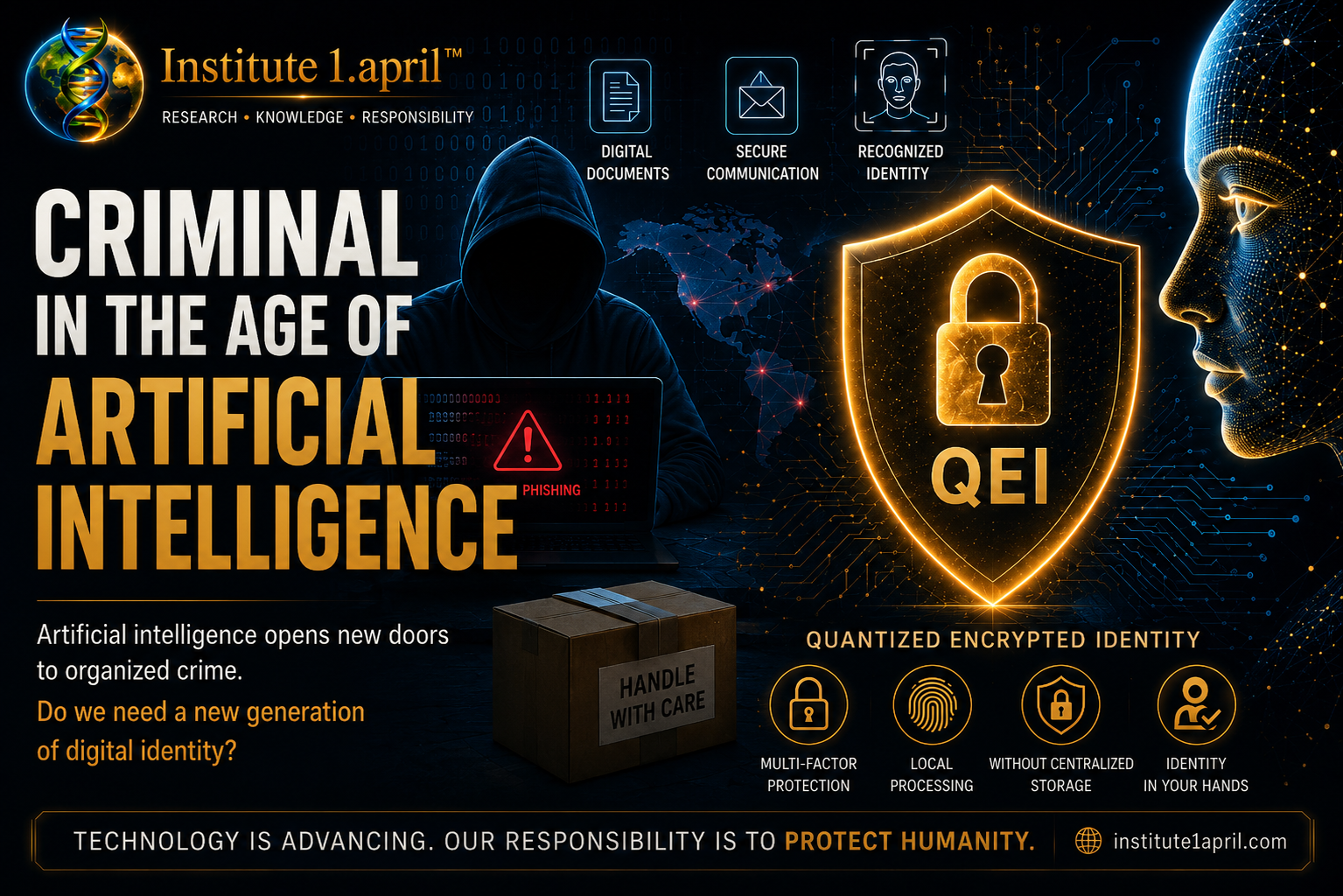
Artificial intelligence is opening new doors for organised crime. Do we also need a new generation of digital identity?
The development of artificial intelligence offers extraordinary opportunities for science, the economy and everyday life. At the same time, however, it is also opening new avenues for abuse, which organised criminal groups are exploiting with increasing speed.
Recent media reports warn that criminal groups are using artificial intelligence to create increasingly convincing scams, fraudulent documents, fake emails, forged identities and other forms of digital crime. These technologies are making such scams increasingly difficult to detect, both for individuals and for businesses and public institutions.
This is no longer a question for the future – it is a reality of the present.
Today’s trust systems are becoming increasingly vulnerable
Most of today’s digital systems still rely on passwords, user accounts, SMS codes, emails or documents that can be stolen, intercepted, forged or convincingly replicated using artificial intelligence.
If artificial intelligence can create an almost perfect imitation of a voice, photograph, document or email, it becomes clear that we will need to consider entirely new ways of verifying identity.
The question is no longer whether artificial intelligence will change the way criminals operate.
The question is whether we will develop technologies capable of keeping pace with these developments in time.
QEI development status
QEI is a conceptually designed digital identity system currently in development and in preparation for a research pilot. Its technical, security and operational properties have not yet been validated in a production environment. The proposed pilot is specifically intended to verify the system’s feasibility and the stated hypotheses.
How could the QEI system help?
The QEI (Quantized Encrypted Identity) initiative takes a different approach.
Rather than having trust rely primarily on documents, passwords or one-time confirmation codes, the proposed design envisages the use of multiple independent security elements that would together form a protected digital identity for the individual.
The fundamental principles of the proposed design include:
- multiple independent security factors,
- local identity verification on the user’s device,
- protection of biometric data without centralised storage,
- reducing the possibility of digital identity takeover,
- a Privacy by Design approach, in which privacy protection is incorporated into the system from the outset.
Such a concept does not, in itself, mean that digital crime could be eliminated completely.
However, if the proposed design were successfully implemented and technically validated, it could significantly reduce the potential for successful identity misuse, which represents one of the greatest risks in modern cybercrime.
“If artificial intelligence is becoming a tool for criminals, it must also become the most powerful tool for protecting identity.”
— Institute 1. april
Technology must stay one step ahead of crime
Criminal organisations adapt very quickly to new technologies.
Society can therefore no longer focus solely on responding to crimes after they have already been committed. Increasing attention must be devoted to prevention and to developing security solutions that reduce the potential for misuse from the outset.
Digital identity is becoming one of the most important foundations of modern society. Access to public services, healthcare, banking, education, electronic commerce and many other areas will depend on it.
If we want to preserve trust in the digital society, identity protection must become one of our highest priorities.
The purpose of the Institute 1. april initiative
At Institute 1. april, through the public discussion on the QEI initiative, we aim to encourage professional and academic communities, as well as the wider public, to reflect on the future of digital identity.
Our objective is not merely to draw attention to individual cases of online fraud, but to open a discussion about how new technological approaches could better protect people, their personal data, their digital identity and their assets.
We believe that the future of digital security will be based on solutions that place people at the centre of the system and combine security, privacy and the responsible use of technology.