When a child doesn’t respond: how QEI could turn silence into a signal for help
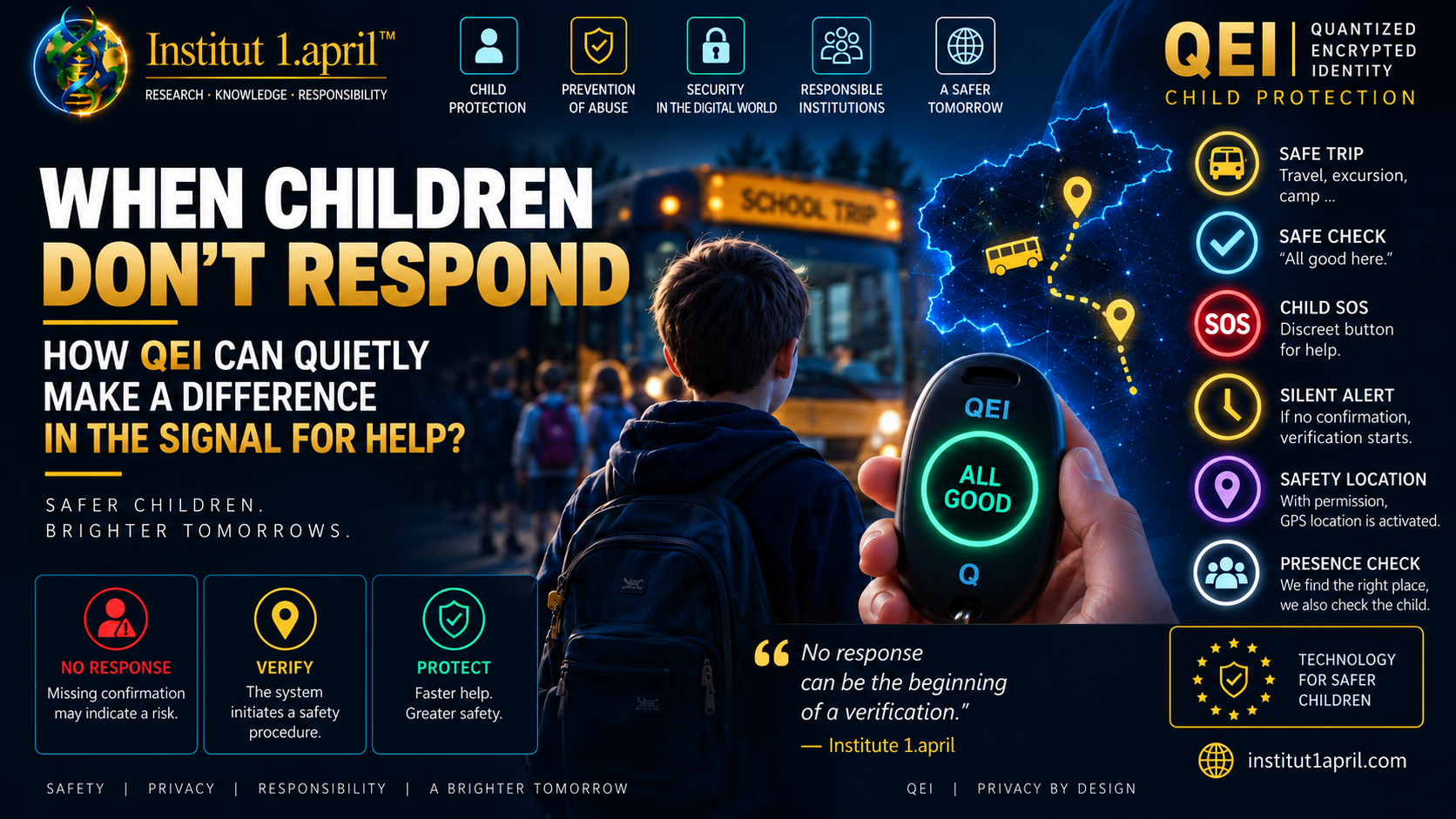
A child goes to school, on a school trip, to camp, training, or on a journey. Upon arrival, with a single press, they confirm: “I’m safe.” But what if that confirmation never comes? What if the child cannot make a call? What if someone takes away their phone or protective device? As part of the QEI – Quantized Encrypted Identity initiative at Institute 1. april, we are developing a concept in which the absence of an expected signal itself could become a reason to initiate a safety check – without the need to constantly track the child.
When one press means: “I’m safe”
When it comes to protecting children, technology often tries to answer the question of how to monitor a child.
With QEI, we want to turn that question around:
How can we enable a child to simply confirm that they are safe – and how can we detect in time when that confirmation is missing?
Imagine a child going on a school trip.
Before departure, a temporary safety mode is activated on their protected device or QEI Child Key:
QEI SAFE TRIP
An expected arrival window is defined. When the child arrives safely, there is no need to send their location, photographs, or other personal data.
They simply press:
I’M SAFE
The system receives the confirmation and the safety event is closed.
If everything is fine, the system needs nothing more.
Prove the necessary attribute with the minimum possible disclosure of personal data.
“If everything is fine, one press is enough. If there is no response, the verification process begins.”
— Institute 1. april
What if the child does not press the button?
A missing confirmation does not in itself mean that the child is in danger.
The child may simply have forgotten.
The device battery may be empty.
The bus may be delayed.
There may be no mobile signal.
For this reason, QEI should not automatically trigger an intervention simply because a child missed one confirmation.
Instead, a graduated safety procedure would begin.
1. SAFE CHECK
The system detects that the expected confirmation has not been received.
2. FOLLOW-UP PROMPT
The child receives a discreet prompt to confirm their safety.
3. LOST CONTACT
If there is still no response, the system attempts to verify the status of the protected device.
4. SAFETY LOCATION MODE
If predefined safety conditions are met, device location may be activated.
5. PRESENCE CHECK
Finding the device does not mean that the child has been found. It must be verified whether the child is actually with the device.
6. PROTECTIVE RESPONSE
If the child’s safety cannot be confirmed, the case is transferred, in accordance with a predefined protocol, to an authorized person or competent service.
When silence becomes a signal
Perhaps the most important part of the concept is precisely what the child does not do.
A child in danger may not be able to make a phone call.
They may not be able to write a message.
Someone may be watching them.
Someone may have taken away their phone.
They may not even be able to safely press an SOS button.
That is why we are also exploring the concept of:
QEI SILENT ALERT
If a protection mode has previously been activated and the child does not complete the expected Safe Check within the agreed time period, the absence of confirmation could trigger a safety procedure.
This means that the child would have two routes to assistance:
active: the child presses SOS or the Panic Trigger;
passive: the expected safety confirmation is missing.
In certain circumstances, silence itself could mean:
“Check whether I am safe.”
QEI Child SOS – a direct button for help
The QEI Child Key could also include a dedicated safety button:
QEI CHILD SOS
If a child senses danger, they could trigger a cryptographically verified signal by pressing and holding the button or using another specifically defined activation method.
In simplified form:
QEI CHILD KEY → SOS → VERIFIED DISTRESS SIGNAL → AUTHORIZED RESPONSE
A child in danger would not need to search for a telephone number or explain the situation at a moment when they may be unable to do so.
The signal would mean:
“A verified protected device has triggered a request for assistance.”
However, it would not automatically mean that a criminal offence had been established. The actual circumstances must be assessed by people and the competent institutions.
What if someone takes the device away from the child?
This is one of the most important scenarios.
A protection system must not be designed in such a way that a potential source of danger can disable it simply by taking away the child’s phone or key.
If Safe Trip or another protection mode has already been activated, removing the device would not erase the expected next Safe Check.
If the child does not provide the confirmation, a Lost Contact procedure could be triggered.
The system could therefore detect:
expected Safe Check not completed → device not responding → additional verification required.
This is an essential difference between an ordinary SOS button and the broader QEI Child Protection concept.
GPS – but not as constant surveillance of the child
When contact with a child is lost, location can become life-saving information.
QEI Child Protection should therefore also explore the possibility of GPS or another appropriate method of locating the protected device.
But the boundary must be clear.
The goal must not be to create a 24-hour map of a child’s life.
Under normal conditions:
SAFE STATUS: OK
GPS SAFETY ACCESS: OFF
In the event of a justified safety incident:
CHECK-IN MISSED
CONTACT LOST
SAFETY PROTOCOL ACTIVATED
LOCATION ACCESS: AUTHORIZED
Location would therefore be used for a specific protective purpose and according to predefined rules, rather than as a default means of constant surveillance.
The technical design would need to define precisely when location access may be activated, who may view it, how long the data remains accessible, and when it must be deleted.
We found the device. But did we find the child?
This is a crucial safety distinction.
The location of the QEI Child Key is not necessarily the location of the child.
The child may have lost the device.
They may have left it on the bus.
Someone may have taken it away.
Someone may have discarded it.
The device may remain in one place while the child is somewhere else.
QEI should therefore never conclude:
DEVICE FOUND = CHILD FOUND
A further step would be required:
QEI PRESENCE CHECK
The system or responsible person would need to confirm:
DEVICE LOCATION VERIFIED
and separately:
CHILD PRESENCE VERIFIED / NOT VERIFIED
The method used for such verification would need to be subject to professional and technical assessment. It could involve local user verification, another protected element, a trusted institutional point, or direct physical verification.
If the device is found but the child is not:
CHILD PRESENCE NOT VERIFIED → HIGHER SAFETY RESPONSE
This would be significantly more important information than the GPS coordinates alone.
What if the child no longer has their device?
Taking away one device should not mean taking away the child’s ability to seek help.
The broader concept should therefore also provide alternative trusted points.
A child could trigger a request for assistance through an appropriately protected system at a school, healthcare facility, social services centre, police station, or another authorized location.
The fundamental principle would be:
A device can be taken away. A child’s right to seek help should not be something that can be taken away.
From a school trip to more serious circumstances
Such a system would not be intended only for extreme cases.
On an ordinary school trip, it could be very simple:
DEPARTURE → SAFE TRIP → ARRIVAL → “I’M SAFE” → END
If the child does not confirm their arrival:
NO CHECK-IN → REMINDER → CONTACT CHECK
Only if contact cannot be established for a longer period, or if additional risk factors exist, would the protective procedure be escalated.
In more serious circumstances – for example, where a child is considered particularly vulnerable – a professionally defined protocol could require more frequent checks.
The system would therefore adapt to the level of risk rather than monitoring every child with the same intensity.
QEI Child Safeguard – checking the system, not only the child
There is another side to the problem.
What if a child sends an SOS and nobody responds in time?
What if a safety check was required but nobody carried it out?
QEI could provide a cryptographically protected audit trail of safeguarding events:
SIGNAL RECEIVED → RESPONSIBILITY ASSIGNED → SAFETY CHECK REQUIRED → ACTION RECORDED
Not to create a detailed centralized record of the child’s life.
Rather, to make it possible to verify whether the institution responsible for taking action actually fulfilled its duty.
This leads to another important principle:
Prove the necessary attribute with the minimum possible disclosure of personal data.
“Do not track the child. Track whether the system is fulfilling its duty to the child.”
— Institute 1. april
Proposed architecture
The research concept could consist of several interconnected functions:
QEI CHILD KEY™
protected device or credential
QEI SAFE TRIP™
temporary protection mode for a journey, school trip, or another defined period
QEI SAFE CHECK™
simple “I’m safe” confirmation
QEI CHILD SOS™
active signal for assistance
QEI SILENT ALERT™
safety procedure triggered by a missing expected confirmation
QEI LOST CONTACT MODE™
graduated verification when contact is lost
QEI SAFETY LOCATION™
conditional device location in the event of a justified safety incident
QEI PRESENCE CHECK™
separate verification of whether the child is actually with the located device
QEI CHILD SAFEGUARD™
traceability of safeguarding obligations carried out by responsible institutions
Together, these could form the:
QEI CHILD PROTECTION ECOSYSTEM™
Privacy must not become the price of safety
Technology of this kind carries a serious risk: a system created to protect children could become a system for monitoring them.
That is why the principle of Privacy by Design must be embedded in the architecture from the very beginning.
The questions must be asked before the system is built:
Who can activate location tracking?
Can a parent or guardian disable the protection?
What if the guardian is themselves a potential source of danger?
How can misuse of GPS data be prevented?
How long is the data retained?
Who can link a QEI token to the child’s actual identity?
How is it verified that the child is together with the device?
What happens in the event of a false alarm?
What happens if another person is using the device?
How can a child cancel an alarm without another person being able to force them to do so?
These are not details for a later stage.
They are fundamental questions of the system.
QEI cannot guarantee that abuse will not occur
Even with a system designed in this way, we must be clear about its limitations.
QEI cannot prevent every act of violence, abduction, abuse, exploitation, or human trafficking.
Nor can it replace parents, teachers, social workers, police officers, doctors, psychologists, courts, or other professionals.
What we can explore is whether it could reduce certain critical gaps:
when a child cannot make a call;
when someone takes away their device;
when nobody notices that the child has failed to check in;
when contact is lost and nobody knows where to begin searching;
when the device is found and it is incorrectly assumed that the child has also been found;
or when a child sends a signal but it later remains unclear who was responsible for taking action.
Technology that responds only when we need it
Perhaps the most important principle of this concept is its restraint.
When everything is fine, technology should know as little as possible.
When the child confirms:
“I’m safe.”
that should be enough.
But when the expected response does not arrive, a graduated verification process can begin.
And when there is a justified safety reason, the system can use additional mechanisms necessary to locate and protect the child.
This represents a different approach to children’s digital safety:
not monitoring everything because something might happen one day – but being ready to act when something does not add up.
Prove the necessary attribute with the minimum possible disclosure of personal data.
“If everything is fine, one press is enough.
If there is no response, check.
If contact is lost, locate the device.
If you find the device, check for the child as well.Do not track the child’s life. Make sure that, when in danger, they are never left without a path to help.”
— Institute 1. april
QEI Child Protection, QEI Child SOS, QEI Safe Check, and the related mechanisms are, at this stage, development and research concepts. Before any potential pilot or practical implementation, technical validation, threat analysis, legal assessment, privacy and data protection impact assessments, and the involvement of child protection experts would be required.