When Adults Become “Children” Online: How QEI Could Help Protect Minors
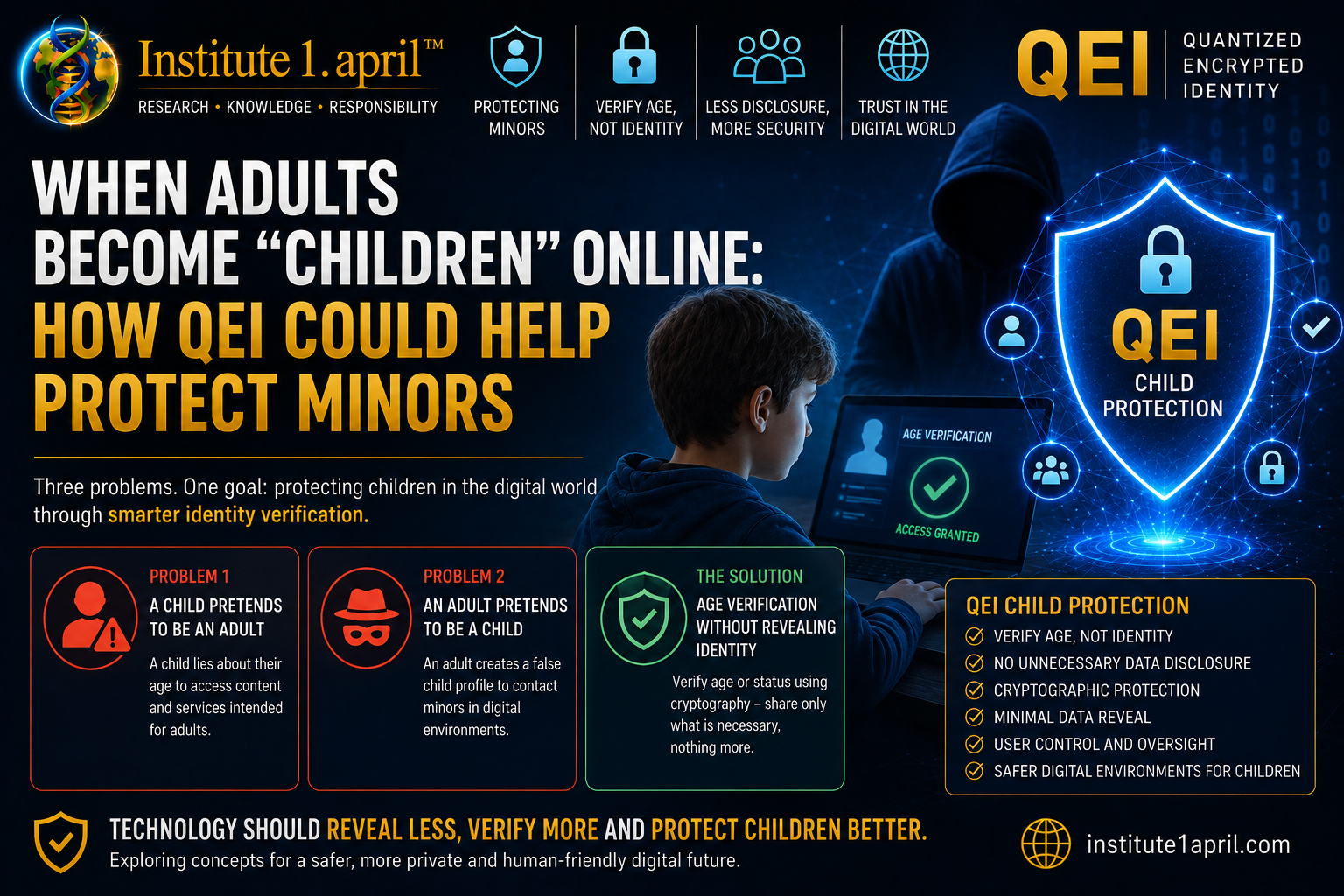
Online, an adult can become 14 years old in a matter of seconds. A child, meanwhile, can become “an adult” with a single click. At a time of increasingly intense discussions about child sexual abuse, paedophilia and online grooming, an important question arises: can the digital identity of the future protect minors more effectively without turning them into subjects of constant digital surveillance? Within the QEI – Quantized Encrypted Identity initiative at Institute 1. april, this is precisely the type of approach we are exploring.
When age on the internet is just a piece of information we enter ourselves
The digital world has given children access to knowledge, communication, entertainment and creativity on a scale previous generations never experienced.
But that same openness has also created a serious problem.
Online, we often do not know who is really on the other side of the screen.
A child can enter a false date of birth and gain access to an environment intended for adults.
An adult can do exactly the opposite.
Within minutes, they can create a profile, choose a photograph, enter a false age and begin presenting themselves as a 13-, 14- or 15-year-old.
For the system, that may be enough.
But a declared age is not the same as a verified age.
And this distinction is becoming increasingly important.
Current discussions about child sexual abuse, paedophilia and online grooming should therefore go beyond political divisions.
The question is not who raised the problem first.
The question is:
What can we actually do as a society to protect children better?
Law, police, the judiciary, education, parents, schools and digital platforms all have a role to play.
But technology must also become part of the answer.
Two sides of the same digital gap
Today’s system has two opposing problems.
The first is a child who presents themselves online as an adult in order to gain access to content or services that should not be available to them based on their age.
The second is potentially even more dangerous:
an adult who presents themselves as a child.
This is particularly important on social networks, in chat rooms, online games, communication apps and other digital environments where an adult can establish contact with a minor.
In online grooming, an offender may gradually gain a child’s trust, conceal their true identity or age, and move the conversation into increasingly private environments.
No technology by itself can prevent paedophilia, sexual abuse or every form of grooming.
But that does not mean technology cannot remove some of the opportunities that make such behaviour easier.
QEI Child Protection
Within the broader QEI – Quantized Encrypted Identity initiative, we see the possibility of developing a specialised subsystem:
QEI CHILD PROTECTION
Its purpose would not be to determine which websites a child visits.
Nor should its purpose be to create a central register of a child’s digital life.
The basic idea is different:
verify the right of access without having to reveal the user’s full identity.
This is an important distinction.
If an online service only needs to know whether a user is over 18, why should it automatically receive the person’s name, surname, address, identity document number and exact date of birth?
Perhaps it only needs a cryptographically verifiable answer:
18+ : YES
or
18+ : NO
This is one of the fundamental principles explored by the QEI concept:
prove the required attribute while disclosing the minimum possible amount of personal data.
“Protecting a child should not mean that the child must reveal their identity to every website. The technology of the future should be able to verify what is necessary without learning everything.”
— Institute 1. april
When “I am 18” would no longer be enough
Today, age verification on parts of the internet is almost symbolic.
A user is asked:
“Are you over 18?”
They click:
YES.
And continue.
Such a solution verifies virtually nothing.
In a QEI Child Protection model, an online service could require digitally verifiable confirmation of the age requirement instead of relying solely on the user’s statement.
Conceptually, the process could be very simple:
user → QEI verification → proof of age category → access decision
If the user is a minor:
QEI AGE STATUS: UNDER 18
ACCESS: DENIED
The service does not need the child’s name.
It does not need their address.
And potentially not even their exact date of birth.
It only learns what it actually needs to know:
the user does not meet the required age condition.
But protection must also work in the other direction
This is where the concept becomes particularly interesting.
What if a certain digital environment is intended for children?
Today, an adult can simply enter:
Age: 14
If the platform does not verify that information, the system may treat that person as a “child”.
With QEI, a different model could be explored.
A user could have a verified age category without having to reveal their identity to other users.
The platform could receive only:
VERIFIED MINOR
or:
ADULT
An adult could therefore not obtain the status of a verified minor simply by entering a false date of birth.
In specially protected digital environments for children, certain functions or spaces could be restricted to verified age categories.
This does not mean adults should be excluded from every environment where children are present.
Parents, teachers, coaches, moderators and other authorised adults may have legitimate roles.
But their role could be clearly defined and digitally verifiable.
An adult would not be a “14-year-old”.
They would be a verified adult with a defined authorised role.
QEI Child Key – a digital key that cannot be bypassed with one click
The next development possibility is a security element that, for the purposes of the concept, can be called:
QEI CHILD KEY
The “key” would not necessarily have to be a classic USB key.
It could be a dedicated physical element, a secure part of a mobile phone, a smart card, a secure element or another technical solution.
Its role would be to protect the QEI credential or participate in proving the required status of the user.
The important point is that protection should not be just a browser setting that can be switched off.
A chain of trust could be established:
QEI identity → protected key → device → verification → digital service
If the user does not have the required authorisation, the service does not grant access.
It does not merely display a warning.
It does not ask for one more click.
Access is simply not allowed.
A child’s identity should not be sent to every website
This is where an important paradox appears.
To protect children more effectively, we need more reliable age verification.
But if the solution means that a child must send an identity document, facial image, date of birth and other personal information to every website, we could create a new problem.
We would be collecting enormous amounts of highly sensitive data about minors.
QEI explores the opposite direction.
More verifiability, less disclosure.
A website does not need the answer to the question:
“Who is this child?”
If the purpose is only an age restriction, it needs the answer:
“Does this user meet the required age threshold?”
These are two very different questions.
Anonymity is not the same as an unverified identity
An adult user should not have to publicly reveal their name simply because a system needs to verify their age.
This is important.
QEI could distinguish between a user’s public identity and cryptographically verified attributes of that identity.
A person may use a nickname on a platform.
Another user does not know their name, address or identity document details.
But the system could still verify:
ADULT – VERIFIED
This opens the possibility of a compromise that is often overlooked in today’s discussions:
privacy and verifiability do not necessarily exclude one another.
Protecting a child must not become surveillance of a child
This is one of the most important boundaries of the entire concept.
In the name of protecting children, it would be very easy to create infrastructure that tracks almost every digital step they take.
Which website the child visited. What they searched for. Who they spoke to. What they read. When they were online.
Such an architecture could become dangerous in itself.
That is why one of the fundamental principles of QEI Child Protection should be:
“Do not track the child. Verify the right of access. Protecting children must not become an infrastructure for monitoring their digital lives.”
— Institute 1. april
If the system only decides whether a user has the right to access a particular service, it does not need to know the child’s entire online history.
Only the information necessary for the specific decision is required.
This means exploring minimal data disclosure, local processing, cryptographic protection, separation of identity from individual credentials and strictly limited access to data.
What would this look like in practice?
Imagine three simple examples.
1. A child wants to access 18+ content
The service requests proof of the age requirement.
QEI confirms:
UNDER 18
Result:
ACCESS DENIED
Without sending the child’s identity document to the website.
2. An adult wants to create a profile of a 14-year-old
Entering “14” is possible.
But obtaining the status VERIFIED MINOR requires an appropriate verifiable QEI credential.
The adult does not have one.
The platform therefore does not confirm the user as a minor.
3. An adult legitimately needs to participate in a children’s digital environment
A teacher, moderator or another authorised person does not need a false child identity.
The system could identify them as:
VERIFIED ADULT – AUTHORIZED ROLE
This could potentially help a child distinguish more easily between another verified minor and an adult with a defined role.
QEI cannot eliminate paedophilia
With such a serious topic, we must draw a clear line between technological potential and promises.
QEI cannot eliminate paedophilia.
It cannot prevent every case of sexual abuse.
It cannot identify every offender.
And it cannot replace the police, the judiciary, social services, schools, child-protection professionals, parents or the responsibility of digital platforms.
But we can ask a different question:
Can technology reduce some of the opportunities that currently enable or facilitate dangerous digital behaviour?
If an adult cannot become a “verified child” simply by entering a false date of birth, one opportunity has been removed.
If a child cannot bypass age verification with a single click, another has been removed.
If this can be achieved without creating huge databases of children’s personal data, their privacy is protected at the same time.
This is the direction of research.
The system should also be resistant to abuse
When developing QEI Child Protection, it is not enough to ask:
How does the system work?
We must also ask more difficult questions:
- How could someone try to bypass it?
- What happens if a device or key is stolen?
- What if an adult uses a child’s device?
- How is a credential revoked?
- How can the creation of multiple false identities be prevented?
- What happens when a child reaches adulthood?
- Who is allowed to change protection settings?
- How do we prevent a government, platform or another party from using the system for unauthorised surveillance?
- How do we guarantee a right to correction if the system makes an incorrect decision?
These are precisely the kinds of questions that distinguish an idea from a serious development concept.
We need technology, law and expertise
QEI Child Protection therefore cannot be merely an information technology project.
Serious development would require cooperation between experts in cybersecurity, cryptography, personal data protection, children’s rights, psychology, prevention of sexual abuse, criminal law, digital platforms and identity-system development.
An independent privacy and security assessment would also be particularly important.
A system designed to protect the most vulnerable must have even higher security standards, not lower ones.
From political debate to the search for solutions
When the public discusses paedophilia and child sexual abuse, it is understandable that the debate becomes emotional.
But protecting children should not belong to one political side.
A child has no political colour.
It is also not enough to ask only who is responsible for the current situation.
We must also ask:
What can we do differently so that the next child is better protected?
Part of the answer is legislation. Part is prevention. Part is education. Part is effective institutions and law enforcement. Digital platforms also carry part of the responsibility.
And in the 21st century, part of the answer must also be technological architecture that builds child safety into its design from the beginning.
QEI Child Protection as a new development direction
Within Institute 1. april, we therefore see QEI Child Protection as one of the possible specialised development directions of the broader QEI system.
At present, we are talking about a development concept, not a completed, implemented or certified product.
Before any possible deployment, architectural development, prototyping, threat modelling, security testing, legal analysis, data-protection impact assessment and, above all, the involvement of child-protection experts would be required.
Only after that would it be responsible to discuss a pilot environment.
But every major solution begins with a question.
Ours is simple:
If the digital world can verify a payment in a few seconds, why should it not also be able to verify the right of access – without unnecessarily revealing a child’s identity?
Protect, do not monitor
The digital future of children must not be a choice between two bad options:
an unverified internet without effective safeguards
or
an internet of complete surveillance and loss of privacy.
We need to find a third path.
A path in which technology can set a boundary without needing a person’s full identity.
A path in which an adult cannot become a “child” with a single entry.
A path in which a child cannot become an “adult” with one click.
And a path in which security does not automatically mean collecting ever more personal data.
This is the direction we want to explore with the QEI Child Protection concept.
Verify age. Protect identity. Restrict dangerous access.
Do not track the child. Protect their digital path.