How countries search for missing children — and could QEI help bring them to safety sooner?
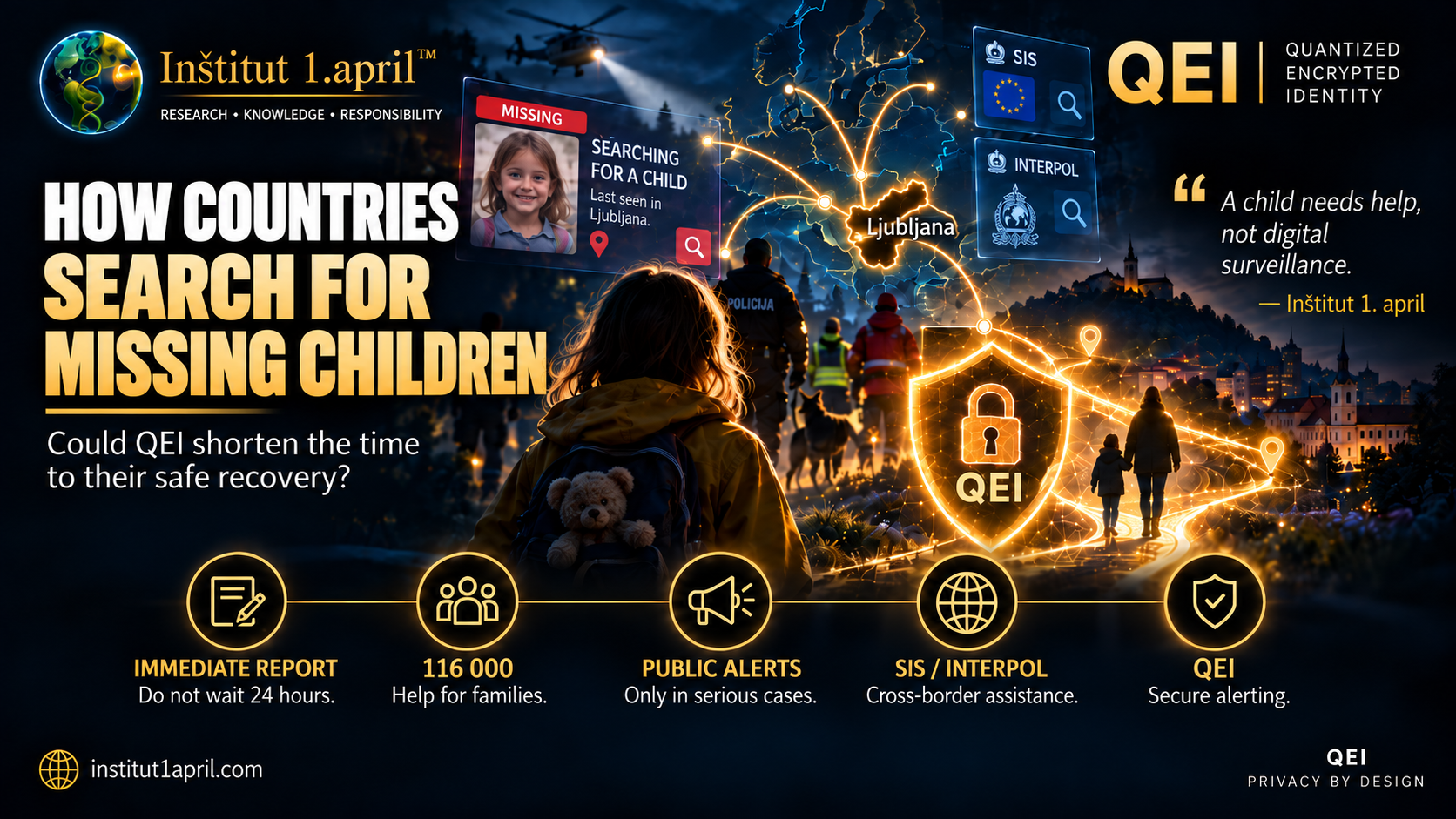
When a child goes missing, even a few minutes can make a difference. How do police, specialist organisations and public alert systems in Slovenia, Europe and the United States respond? And could the QEI research concept support faster, trustworthy information-sharing without turning child protection into permanent surveillance?
The disappearance of a child is one of the most distressing experiences for a family. Parents need answers, police need reliable information and the public can sometimes provide crucial assistance. Yet not every missing-child case is an abduction, and not every case calls for a public alert.
A child may become lost, leave home because of distress, be the victim of a crime or be unlawfully taken by someone else. The response depends on the circumstances, the risk and the information available to the authorities.
Through QEI – Quantized Encrypted Identity, Institute 1 April raises an additional research question: could future digital identity and security technology shorten the journey from an initial report to a safe, verified response while reducing the risk of unauthorised tracking?
1. Slovenia: report a missing child immediately
Slovenian police explicitly state that there is no 24- or 48-hour waiting period before reporting a missing person. When a child or another vulnerable person goes missing, call the police on 113 without delay. The police assess the circumstances and decide which search measures are necessary.
Depending on the case, authorities may review the last known information, interview people, examine relevant leads, deploy search teams and involve other services or the public where appropriate. Information is not automatically made public in every case.
The European 116 000 helpline also provides assistance to missing children, their families and people who have relevant information; it does not replace reporting an emergency to the police.
Slovenian police promote the practical steps check – think – report, but when a child may be in danger, contacting the police comes first.
2. How do different countries search for missing children?
Approaches combine police investigations, national databases, international cooperation, specialist helplines and – for certain high-risk cases – alerts to the public. The criteria for activating an alert vary by country.
| Country / area | Key mechanism | How it is used |
|---|---|---|
| Slovenia | Police (113), rapid response, 116 000 | Immediate reporting; police-led search and public assistance when warranted by the risk. |
| France | Alerte enlèvement | Public alert for confirmed child abductions involving serious danger and actionable information; decided by the prosecutor. |
| United States | AMBER Alert; police and NCMEC | Urgent alerts through phones, broadcasters and road signs in the most serious child-abduction cases. |
| United Kingdom | Police, Missing People, targeted public appeals | Investigations, family support and selected public appeals when authorities consider them appropriate. |
| Schengen area | Schengen Information System (SIS) | Police and border alerts about missing people, including children at risk of abduction; not a public database. |
| International | INTERPOL Yellow Notices | Cross-border police alerts to locate missing persons, including children; some notices are restricted. |
3. When is the public called upon to help?
In the United States, AMBER Alerts are designed for the most serious child-abduction cases. The US Department of Justice recommends criteria involving reasonable belief that an abduction occurred, imminent danger of severe injury or death, enough descriptive information to help with recovery and proper recording of the case.
France’s Alerte enlèvement similarly requires an established abduction, a minor victim, danger to the child’s life or physical integrity and precise information useful for identification. A competent public prosecutor decides whether to issue it, and may withhold the alert if publication could endanger the child or compromise the investigation.
Speed alone is not enough. Alerts must be trustworthy, proportionate and unlikely to put the child at greater risk.
4. What happens when a child may have crossed a border?
When a missing child may be in another country, coordination between authorised agencies becomes essential. The Schengen Information System (SIS) includes alerts on missing people and preventive alerts for certain children at risk of abduction.
Law enforcement can also request an INTERPOL Yellow Notice for international assistance. It is a police cooperation tool, not an app for parents to follow a child’s movements.
The European 116 000 network can provide support to affected families and cooperate on cross-border cases.
Missing Children Europe’s Figures & Trends 2025 report documented 7,881 cases handled by 116 000 hotlines in 22 countries in 2025. This is not the total number of missing children across Europe, because it does not cover all police reports or all countries.
5. How could QEI support a safer response?
QEI could explore ways to complement the work of police and child protection services. The aim would not be to replace investigators, but to improve the authenticity of alerts, the accountability of access and the secure exchange of relevant information.
Verifiable official alerts
An alert could be digitally signed by the competent authority. Another agency or recipient could verify its origin, validity and the issuer’s authority. This could reduce forged warnings and messages falsely claiming to come from the police.
Selective disclosure
The public may need to know a child’s clothing and the general area of their last confirmed sighting, but not their home address, medical details or full identity records. QEI could explore distinct access levels for public notices, law enforcement and specifically authorised experts.
A protected “I am safe” check-in
In voluntary, appropriately protected contexts, a child might be able to signal that they are safe without publishing their location. Such a signal must not be treated as definitive proof of safety: devices can be lost, lose power or connectivity, or be used under coercion.
A missed check-in can only be a reason to assess the situation, not automatic proof of abduction or permission to start surveillance.
Controlled emergency access
Where authorities lawfully need sensitive information, access should be tied to an authorised purpose, limited in time, auditable and subject to suitable approval. No single parent, administrator or person holding a password should gain unlimited powers to monitor a child.
This matters particularly when a child has fled abuse or a caregiver may be a source of danger. The system must protect children against misuse of authority by adults, too.
Cross-border verification and revocation
Authorities could verify the origin and current status of a message without replicating complete identity records in another central database. Once a child is found, alerts should be promptly withdrawn and further dissemination restricted.
6. From the initial report to a safe outcome: a possible QEI role
| Stage | Existing response | Potential QEI contribution |
|---|---|---|
| Report | Police notification and initial risk assessment. | Verifiable source and secure transfer of the report. |
| Assessment | Authorities assess circumstances and threat level. | Role-limited access to relevant protected records. |
| Search | Police operations and selected public alerts. | Digitally signed, time-limited and verifiable alerts. |
| Cross-border | SIS, INTERPOL and police-to-police cooperation. | Verification of authorisation for each information exchange. |
| Recovery | Confirm identity and ensure the child’s safety. | Privacy-preserving identity confirmation. |
| Closure | Withdraw notices and arrange necessary support. | Revocation, access logs and restricted retention. |
7. What dangers would such a system create?
Technology intended to protect children can become a means of surveillance if poorly designed. A QEI child protection concept should therefore reject permanent default location tracking, mandatory implants, mass biometric collection and unrestricted access by carers or administrators.
A particular danger is revealing a child’s whereabouts to an abusive caregiver when the child has reached safety. False alarms can burden emergency services, while information about a missing child can remain online long after a successful recovery.
Independent oversight, lawful and limited access, privacy by design and secure routes to help outside the family may be essential safeguards.
8. What should a research pilot test first?
The sensible starting point would be a simulated environment with fictional child identities and cases, not tracking real children. Researchers could test whether digital signatures expose fabricated official alerts, how quickly revocations propagate, whether role restrictions hold up, and how the system handles a loss of internet connectivity.
Any future pilot involving real children would require careful legal, ethical and security assessment and must follow the child’s best interests.
Conclusion: children need protection, not continuous monitoring
Systems in Slovenia, France, the United States and international networks demonstrate the importance of coordination among people, institutions and reliable information. Police must know when to involve the public, which reports are credible and how to ensure a child’s safety after recovery.
QEI could research trusted alert origin, purpose-limited access and verifiable collaboration. But the measure of success should never be the volume of data collected or the number of sensors deployed. It should be the actual benefit to the child.
QEI is a research and development concept, not a completed or certified missing-child recovery system. These proposals require lawful authority, cooperation with responsible agencies and independent validation.
“When searching for a missing child, every reliable piece of information matters. Good technology should help bring a child to safety, not create a system in which the child can be watched all the time.”
— Institute 1 April
If a child is missing in Slovenia: call police on 113 immediately. For assistance and support, the European missing-children helpline 116 000 is also available. Do not wait 24 hours.
Sources and further reading
- Slovenian police – reporting missing people.
- Slovenian police – What if my child is missing?.
- Missing Children Europe – 116 000 and Figures & Trends 2025.
- US Department of Justice – AMBER Alert criteria.
- France – Alerte enlèvement.
- European Commission – SIS alerts.
- INTERPOL – Yellow Notices.
- UK government – Child Rescue Alert.
This article presents publicly documented procedures and a separate research proposal; it does not imply that QEI currently works with the agencies mentioned.