European Commission responds to QEI strategic initiative
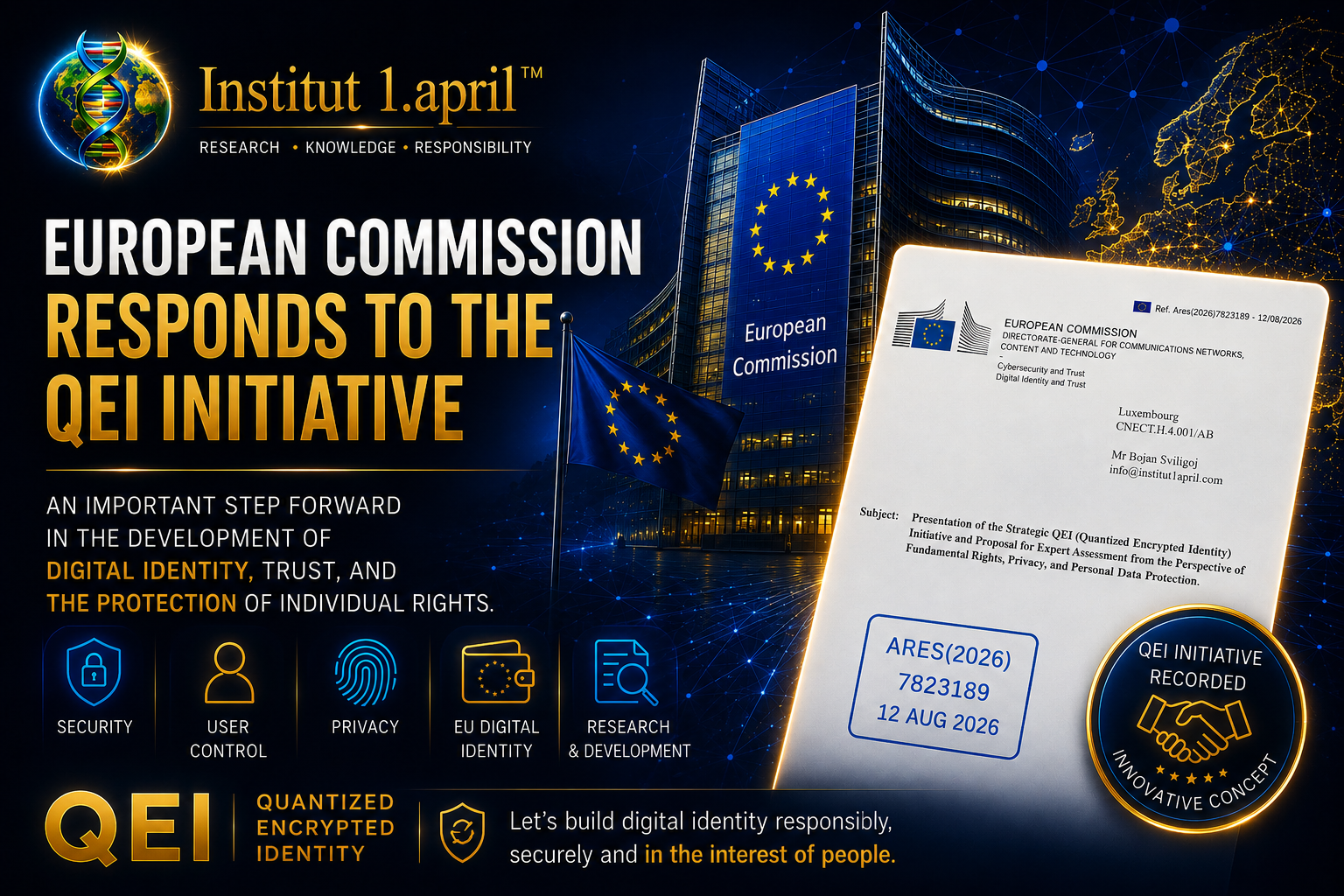
Institute 1. april has received an official response from the European Commission regarding the strategic QEI – Quantized Encrypted Identity initiative, which is intended to explore safer and more privacy-oriented approaches to digital identity.
On 12 August 2026, the European Commission responded to the QEI – Quantized Encrypted Identity initiative presented by Institute 1. april to European institutions as part of the broader discussion on the future of digital identity, privacy and personal data protection.
The response was issued by the European Commission’s Directorate-General for Communications Networks, Content and Technology (DG CONNECT), within the area of Cybersecurity and Trust – Digital Identity and Trust.
The document was signed by Norbert Sagstetter, Head of Unit, and electronically signed on 12 August 2026.
The initiative was registered in the European Commission’s system
In its response, the European Commission confirms that the communication from Institute 1. april was officially registered.
The Commission lists the following reference numbers:
has thereby been officially registered in the European Commission’s
correspondence and linked to the above Ares reference numbers.
The QEI initiative has thereby obtained an official administrative record in its communication with the European Commission.
How did the European Commission describe the QEI initiative?
A particularly important part of the response is the section in which the Commission summarises the content of the submitted initiative.
The European Commission describes it as a proposal for a research concept for a secure, privacy-oriented and technologically advanced digital identity that could contribute to strengthening the protection of individuals and supporting the future development of trustworthy European digital solutions.
This description is important for the initiative’s further development because it places QEI within the broader European discussion on digital identity, cybersecurity, trust and the protection of individuals.
“The digital identity of the future should not be based solely on whether a system can determine who we are. It should also be based on how much data a person must disclose to prove it and who has control over that data.”
— Institute 1. april
Europe is entering a new era of digital identity
In its response, the European Commission also points to the broader European framework.
The European Digital Identity Framework entered into force in 2024, and by December 2026 Member States will be required to provide an EU Digital Identity Wallet to citizens who wish to use one.
Digital identity is therefore becoming one of the key areas of Europe’s digital infrastructure.
The future discussion will no longer focus solely on how to identify an individual.
Increasingly important questions will also include:
- how much personal data an individual must disclose,
- who can access that data,
- how sensitive data is processed,
- how misuse of digital identity can be prevented,
- how users can maintain control over their own identity,
- how security, privacy and the practical use of digital services can be combined.
It is precisely in these areas that the QEI research initiative aims to contribute to further professional and research discussion.
QEI – Quantized Encrypted Identity
QEI is based on the idea that the digital identity of the future should not be designed merely as a collection of personal data stored within a single information system.
The research initiative explores possible architectures that place particular emphasis on:
- personal data minimisation,
- multi-factor identity verification,
- cryptographic protection,
- local processing of sensitive data,
- limiting unnecessary centralised storage,
- traceability of access,
- individual control over the use of identity,
- the principle of Privacy by Design.
The objective is not to create a system that knows as much as possible about an individual.
The objective is to explore whether it is possible to develop a digital identity capable of reliably proving what is necessary without unnecessarily revealing everything.
The European Commission also highlighted funding opportunities
In its response, the European Commission encouraged Institute 1. april to follow the further development of the European initiative through its public channels.
It also specifically referred to the Funding & Tenders Portal, where the European Union publishes funding and participation opportunities.
For the further development of QEI, this represents an important direction.
The next phase of the initiative therefore involves not only the continued development of the concept, but also identifying suitable European research, development and pilot programmes, as well as potential professional and institutional partners.
From an initiative towards research and a pilot environment
The European Commission’s response does not mean that QEI has become an official European Union system or that the European Commission has already confirmed its technical feasibility.
It does, however, represent an important step in institutional communication.
The initiative was received and registered under official reference numbers, while its research purpose was recognised and placed within the context of the future development of trustworthy European digital solutions.
For Institute 1. april, this therefore opens the next important question:
How can the research concept gradually be transformed into a verifiable prototype and pilot environment in which its security, technical and privacy-related properties can be independently evaluated?
This will be one of the key next steps in the further development of the QEI initiative.