QEI and the future of European digital identity

The European Union is developing important digital projects, most notably the EU Digital Identity Wallet and the digital euro.
The purpose of these initiatives is to enable citizens to use digital services throughout the European Union in a safer, simpler and more connected way.
At Institute 1. april, we welcome these developments. The digitalisation of public services, secure electronic identification and reliable identity verification represent an important step towards the future of European society.
At the same time, we believe that every new generation of digital identity also raises new questions about privacy, security, user trust and the long-term resilience of systems. This is why we have developed the Quantized Encrypted Identity (QEI) research initiative, which we would like to present as a potential contribution to the further development of European solutions.
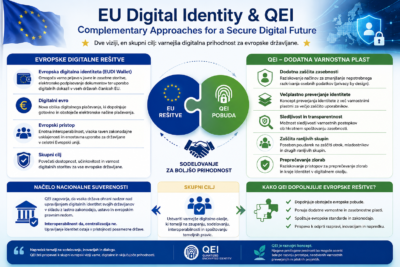
What do European solutions offer?
European digital identity will enable citizens to securely access public and private services, electronically sign documents and use digital credentials in all Member States of the European Union.
The digital euro represents a proposed new form of digital payment intended to complement cash and existing electronic payment methods.
These are important European projects whose objective is to increase the accessibility, efficiency and security of digital services for European citizens.
QEI development status
QEI is a conceptually designed digital identity system currently in development and in preparation for a research pilot. Its technical, security and operational properties have not yet been validated in a production environment. The proposed pilot is specifically intended to verify the system’s feasibility and the stated hypotheses.
Where do we see opportunities for further development?
The QEI initiative explores additional possibilities in the following areas:
- protecting individual privacy,
- reducing the unnecessary disclosure of personal data,
- multi-layer identity verification,
- traceability of security procedures,
- protecting children and other vulnerable groups,
- preventing the misuse of digital identities.
The objective of QEI is not to replace European solutions, but to explore whether certain approaches could be used as an additional security layer or as a complement to future digital identity systems.
Comparison of approaches
| European digital solutions | QEI initiative |
|---|---|
| EU-wide interoperability | Exploration of additional methods of identity protection |
| High degree of legislative harmonisation | Emphasis on additional privacy protection |
| Digital identity for public and private services | Concept of multi-layer identity verification |
| Ease of use for citizens | Exploration of advanced security mechanisms |
| Large European digital ecosystem | Proposal for the further development of security approaches |
The principle of national sovereignty
The QEI initiative is also based on the principle that each country should retain control over the management of its citizens’ digital identities in accordance with its own legislation, constitution and the European legal order.
The proposed QEI concept therefore follows an approach in which digital identity could be interoperable and usable internationally, while identity management would remain under the jurisdiction of each individual country. In our view, such a model could contribute to greater public trust, increased transparency and a clearer allocation of responsibilities between national institutions and shared European systems.
The objective of the initiative is not to centralise all identities in one place, but to explore the possibility of developing secure and interconnected solutions that respect both national sovereignty and common European standards.
“The future of digital identity is not a competition between systems, but a shared search for solutions that provide people with greater security, more privacy and greater trust.”
— Institute 1. april
A shared objective
European initiatives in the field of digital identity and the QEI research concept share a broad common objective – to contribute to a safer digital environment in which citizens have greater confidence when using digital services.
We believe that the greatest progress is achieved when new ideas are included in open professional discussion, collaboration and the exchange of knowledge.
We therefore wish to present the QEI initiative to European institutions as a constructive contribution to the discussion on the development of Europe’s future digital identity. We believe that open dialogue among researchers, developers, Member States and European institutions can contribute to the development of even safer and more trustworthy digital solutions.
QEI is a research initiative that aims to contribute new ideas in the fields of identity protection, privacy and digital security. We believe that the future of digital identity is based on cooperation, interoperability, respect for fundamental rights, national responsibility and a shared European vision of a secure digital future.